
Conditions are the Core of Dungeon World 2
As long as Dungeon World 2 has been in development, there's been a lot of feedback and discussion around Conditions. While our recent post about Struggles touched on them briefly, it's been a while since we talked about Conditions as the main subject. Here I want to dive into DW2's Conditions system: how it works, why we believe in it, and what type of play it helps create. At the end I'll also preview some optional rules for Conditions that we're working on as well.
As a reminder, our Kickstarter launches on January 12th. If you aren't already following us, please do so here. It really helps our campaign reach more people.
How Conditions Work
If you've been following DW2's design from the beginning, you've seen Conditions go through some major iterations. I won't detail every old version, but what we settled on in the Beta looks quite different from what we started with in the Alpha Blue (R.I.P. Embarrassed my beloved). Here is how Conditions work now, taken word-for-word from the Beta v3:
Conditions represent exhaustion, frustration, maladies, or emotions that affect a PC as they adventure. They usually happen as a result of a Player’s choices, and are rarely inflicted specifically upon you. A Condition can be either marked or locked. There are five total Conditions:
- Angry. When marked or locked you have DIS on all +INT rolls. Who or what are you angry at? Does it simmer or explode?
- Distracted. When marked or locked you have DIS on all +WIS rolls. What stubborn worry or feeling won’t go away? How does it manifest?
- Exhausted. When marked or locked you have DIS on all +STR rolls. What tired you out? How does your fatigue show?
- Frightened. When marked or locked you have DIS on all +DEX rolls. What fear or memory is related? Why do your instincts scream?
- Insecure. When marked or locked you have DIS on all +CHA rolls. What made you feel you might not be enough? How do you react?
Clear, Marked, and Locked Conditions
Each Condition is represented by a circle on a PC’s character sheet, which has three states:
◯ Clear — The circle representing the Condition is empty. The Condition is inactive and it doesn’t affect your character.
⦵ Marked — The circle has a line or two through it, representing that the Condition is active and it’s currently affecting your character.
⬤ Locked — The circle is fully filled in. Not only is the Condition active and affecting your character, but it won’t clear under normal circumstances. Only effects that specify that they clear locked Conditions can do so, such as Enjoy Downtime or Reveal Your Struggle.
When a PC has to mark or lock a Condition, their Player chooses one and then describes how their character suffers it in the fiction. While they have a marked or locked Condition, the PC can use the questions beside it to inform how it might affect their roleplaying.
Rare circumstances, such using certain magic items, may require a PC to mark a specific Condition. If they already have that Condition marked, they instead lock it. If it's already locked, then they mark another Condition of their choice.
When a PC marks their last Condition, they trigger Reach Your Limit.
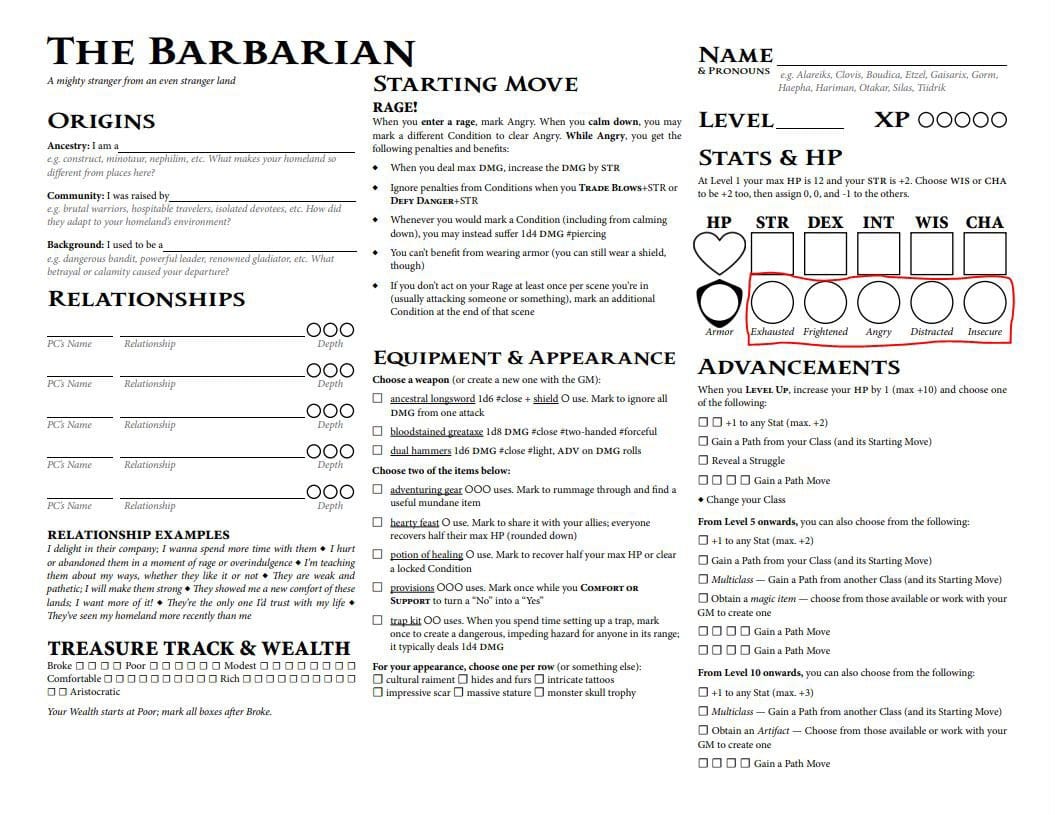
Conditions are, at their core, prompts for the players to interpret and express the internal states of their characters. Each one is single word, but comes with two questions that help players fit it into their character and the current situation.
So Why Conditions?
Conditions are probably the singular most consistent mechanic in our vision for the game. Even if their implementation changed over the course of development, their presence was never in doubt. We were, and still are, confident that they are one of the most important parts of the DW2 experience.
Training Wheels for Good Characters
Conditions teach the basics of dramatic roleplaying by encouraging the players to engage with the difficult, messy, human emotions that every PC is capable of. It's easy to play "Coolshades McSwordguy who's only emotions are 'vengeance' and 'snark'", but it means something when Coolshades finally puts down their sword, takes off their sunglasses, and shows you the haunted look underneath it all. "Be a fan of the player characters" is frequent GM advice that I agree with, which is why Conditions help you make characters that are worth being fans of.
Flexible and Varied
Conditions are flexible, more so than they might first appear. With HP present to handle the more dangerous physical consequences, Conditions can handle some of the softer ones. A Condition will usually be marked by a player in order to gain a benefit or avoid a different consequence. If you look down at your character sheet and don't see any conditions that would make sense to mark right now, it's rare that you would be forced to do so. Furthermore, each Condition can be roleplayed in a variety of ways. When Angry, are you quiet or loud about it? Do you act rashly or stew on it? Is it a controlled burn or a sudden explosion? What might calm you, and what might just make you more irate? Each time you mark a Condition, you can decide how it fits your character this time, and how that is the same or different compared to last time.
Friction that Brings the Party Together
Conditions do carry penalties, but the Moves surrounding them ensure that those penalties push the group to work together, and grow stronger because of it.
- Conditions do give DIS on rolls, but that can be overcome by working together using the Aid a PC Move. If one PC Aids you, you roll normally. If a second person Aids you, you can still roll with ADV.
- Conditions can be cleared by receiving Comfort and Support from another PC. Depending on how the comfort or support is offered, this could take just a few moments. There is no dice roll and no uncertainty in it. Each PC can use the Move once per session, so a group of four PCs can clear up to 12 Conditions combined each session this way. By relying on each other, you can get rid of any Conditions you don't want.
- Make Camp also clears a Condition for each PC, though it advances Threats and can only be done once per session. Still, the PCs resting is inherently done together (even if the PCs are physically apart) and creates a feeling of fellowship. If you can't receive Comfort or Support, or just don't want to talk about a particular Condition, you still have one way to clear it.
- If you mark all Conditions, you Reach Your Limit, make a big outburst, lock one Condition, then clear all the rest. The outburst will likely impact the rest of the group and will affect your relationships with them in the future.
- As we talked about in a previous post, if you have a locked Condition you can clear it by Enjoying Downtime with your companions, or by Revealing a Struggle to them. Either way, your relationship with the PCs has or will change because of the now-cleared Condition.
And all of that is just from the core rules. There are so many Paths, Bonds, Struggles, and more that all tie into this system. Here are some of my favorites:
Eye in the Sky (Starting Move, Druid Stargazer Path)
You have a special connection to the sun(s), moon(s), and stars. You always know the time and date, and can never get lost while you can see the sky. While outside during the day, ignore DIS from being Frightened and gain +1 Armor. While outside during the night, ignore DIS from being Insecure and deal +1 DMG.
Tears of Annalise (Magic Item)
Cloudy red gemstones the size of a thumbnail, the tears of Annalise are always found in pairs
When you and another PC each swallow a tear, you can feel the other’s strong emotions, particularly sadness, loss, fear, or desire. Whenever one of you marks a Condition, the other may mark one instead. The effects last until one spills the blood of the other.
Reformed (Struggle) — Guilt 🗹🗹☐
You did terrible things in the past, and now seek atonement.
Questions: Which PC used to be your enemy? Who doesn’t think you've changed? What do you regret the most?
Haunted (+-) — You start with 2 Guilt; mark it now. When you act selfishly, you may mark Guilt to gain ADV on a roll. Whenever you have fewer marked+locked Conditions than your Guilt (including when you first gain this Struggle), immediately mark Conditions until they match.
Reparation (+) — Once per session, when you significantly help an NPC (GM's call), clear 1 Guilt and a Condition.
Retribution (+) — When you Trade Blows with someone from your villainous past, add your Guilt to all DMG dealt to them.
NPCs also have Conditions, but they work much differently. We'll talk about NPCs in a different upcoming post.
Optional Rules
Every table has different needs and preferences, and so Helena and I have been building a list of optional rules to be added to the final text of DW2. They are a very early first draft, so we'll see if they make it into the final text, but here is an early preview of some of the ones that relate to Conditions.
Condition Severity
Instead of just affecting you or not, conditions have multiple levels of severity. For example:
- "Angry 1" give you a -1 penalty to INT rolls
- "Insecure 2" gives a -2 penalty on CHA rolls
- "Frightened 3" gives a -3 penalty on DEX rolls, which is the lowest
When you "clear a Condition" you reduce its severity by 1, to a minimum of 0.
When you "mark a Condition" you increase its severity by 1, to a maximum of 3.
When you "lock a Condition", you set its severity to 3.
When you "clear a locked Condition", you clear it entirely no matter its severity.
This makes Conditions more complex to manage, but also provides room for more emotional complexity. It will be harder to entirely clear everything, but the lightest severity is less punishing than DIS.
Unnamed Conditions
Conditions no longer have a specific emotion associated with them. Instead, the PC can choose a specific stat and say how they received a penalty to it (physical, emotional, circumstantial, etc.). For example, a PC who marked a condition from casting a Fireball can mark CHA and say they received a recent burn.
This opens up conditions to be anything the players want. The drawback is that not all players are good at coming up with meaningful narratives for conditions, and may say something equivalent to a "stubbed toe".
And that's all for today. We're working hard on the next Beta and a new Quickstart, but no dates yet on either of them.
Thanks for reading!
- Spencer