
Paths - Restructuring Classes and Advancements

When starting designing DW2's Final Alpha, I wrote down a list of goals that I believed would improve the game and address the issues I talked about last week, especially with regards to classes and character creation.
Character creation is such an important aspect of TTRPGs. "Looking at a character sheet" is how some people first engage with a new game at all, which I've heard from multiple people while running DW2 games. Character creation is often the first (and sometimes only) chapter of a TTRPG that is read. Your character sheet distinctly identifies you in relation to the other players at the table. For complex games, you might choose a pre-generated character instead of creating one yourself, especially if you're new.
Character Creation is a huge first impression. With the questions it asks and choices it makes, a game's character creation process communicates how it wants you as a player to think about your character and the game. So I started thinking about how DW2's communication here could be improved.
Class Goals
This isn't every goal for the alpha overall, but here is what I had in mind when rethinking Class structure.
Start Simple
I want people to be able to learn DW2 by sitting down and playing it, without needing to prepare or read anything before their first session. Whether you're new to TTRPGs or a seasoned indie game designer, if you're new to this game then learning its rules is probably enough of a mental load as-is. I don't want you to need to learn or reference other parts of the game in order to make choices during character creation.
Gradually Add Opt-in Complexity
While I want DW2 to start simple, I also want it to become more complex over time as players get more comfortable with the game and their characters level up, and I want to do this through advancements. Typical PbtA advancements act as optional rules that apply only to the player that chooses them. For example, when you make a Wizard, you are choosing the "optional rules" of how they cast magic.
I want to lean into this mindset and present more of DW2's mechanics as advancement options. If someone wants to maintain the same level of mental load when they advance, they can choose simpler advancements. If they want to engage with meta-currencies, additional stats, or more complex moves, those are also available to choose from.
Increase Reader Excitement
Blue and Red work really well in play, but I want more people who read the game to say "wait, I can do that?!" and start wanting to play. We loved the community reception to the Wizard when it was first unveiled, and I want to further evoke that sense of excitement and interest.
Broaden Class Identity
Between Blue and Red (and the pre-alphas) both Helena and I have grappled with the identities of each class. Should the fighter be a brawler or a tactician? Is a wizard always a scholar? What feels "core" to a class and what is peripheral is a matter of some debate, so I want to try expanding the number of advancements and give players more room to interpret the class in different ways.
A New Class Structure
With the goals above in mind, and spending months sitting with it, here is what each class in the Final Alpha will consist of. Some parts will be very similar to Red and Blue, but some will be different.
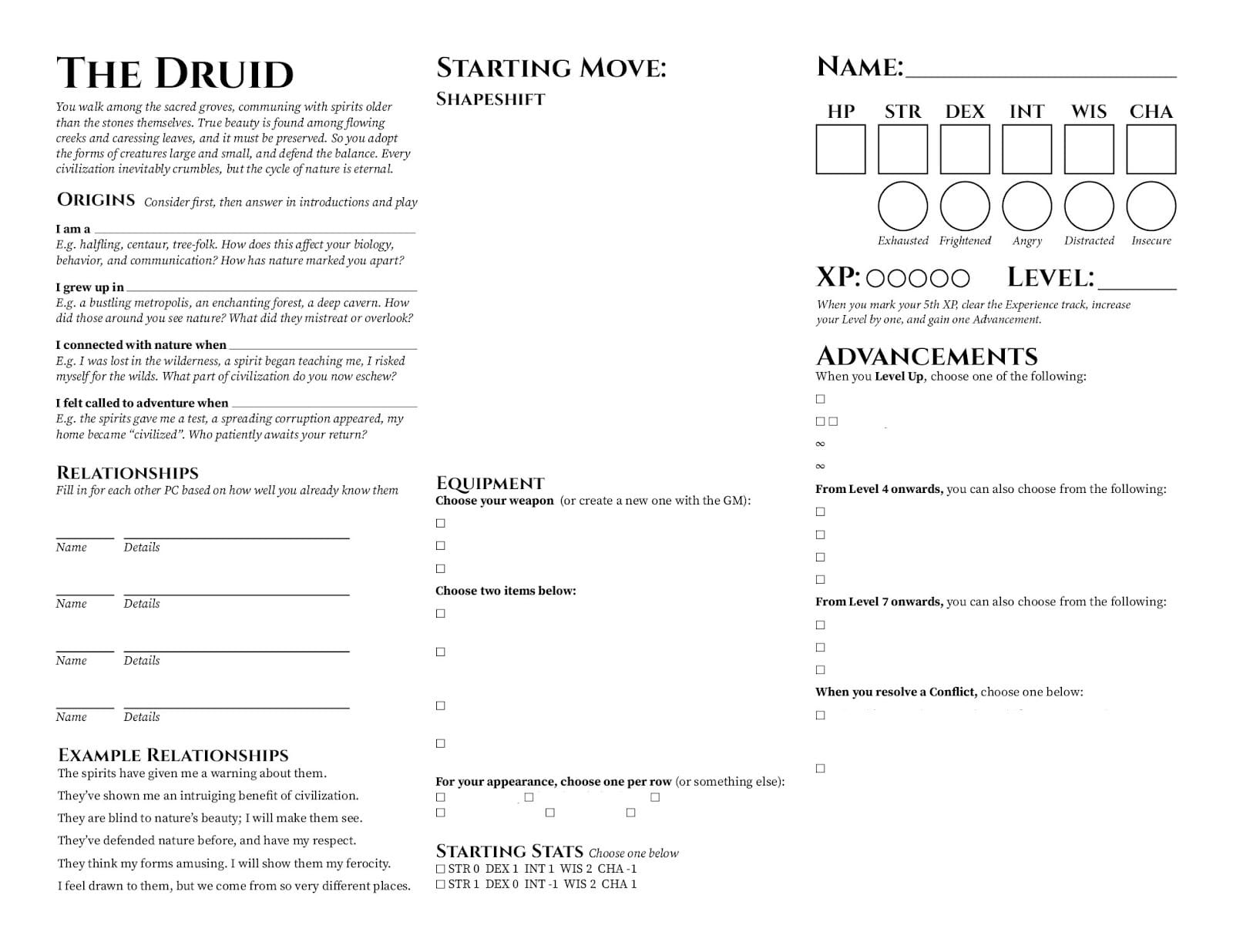
The First Page
During character creation, these are the parts of the sheet that you'll go through in order.
- Origins. This series of questions asks about your character's appearance and history. While this was already in Blue and Red, here in the Final Alpha they've been rewritten substantially and made more specific to each class.
- Relationships. We'll get into how relationships work (and what happened to Bonds) in the next post, but for now I'll just say that your ties to each other PC can be tracked here. You start with a Relationship with every PC instead of just one, and you have six example Relationships to help give ideas.
- Starting Move. A single powerful core Move that embodies your class, which grows more powerful and/or versatile as you gain Paths (detailed below).
- Equipment. Both practical and aesthetic gear you can choose. This is similar to Red, but the effects and details of each item is listed here on the same page, so you don't need to look at other parts of the game.
- Starting Stats. Unlike in Red and Blue, where you set your stats from a list of numbers, here you pick between two significantly different arrays. While this is less D&D-like than fully open stat assignment, it is also much faster at the table. If we keep this method as the default in the beta, we plan to add a few optional rules for those that want to change it.
- Name and Pronouns. These are empty spaces for you to put your character's name and what pronouns they go by.
After character creation you'll also engage with these sections of that same page:
- Stats and Numbers. In this corner of the sheet you'll track stats, conditions, HP, XP, Level, etc.
- Advancements. This list of advancements is mostly the same for each class, but has sections that require Levels 4+, 7+, or a resolved Conflict to get (detailed in a future post). Some now show an infinity symbol instead of a checkbox, indicating you can choose that many times as you want.
That's all on the first page. Here is a preview of how it all looks for the upcoming Druid (with most details hidden, as this post is focused on class structure rather than individual moves).
The Second Page
The second page is entirely devoted to Paths - groups of moves that each act as "specializations" for their associated class.
Each Path has a starting move that makes up its core identity, and four advanced moves that expand or build upon it. When you Level Up, you can unlock a Path and gain its starting move, or you can gain an advanced move from a previously unlocked path. As you reach higher levels you can unlock a total of two paths from your own class and two from other classes.
The first two times you level up, Advancement will be relatively quick and streamlined with not too many choices to make. However, once you increase in levels and unlock more options (getting more familiar with the game as well), the number of choices expands greatly.
Here is what the Bard Paths look like (again, with details removed).
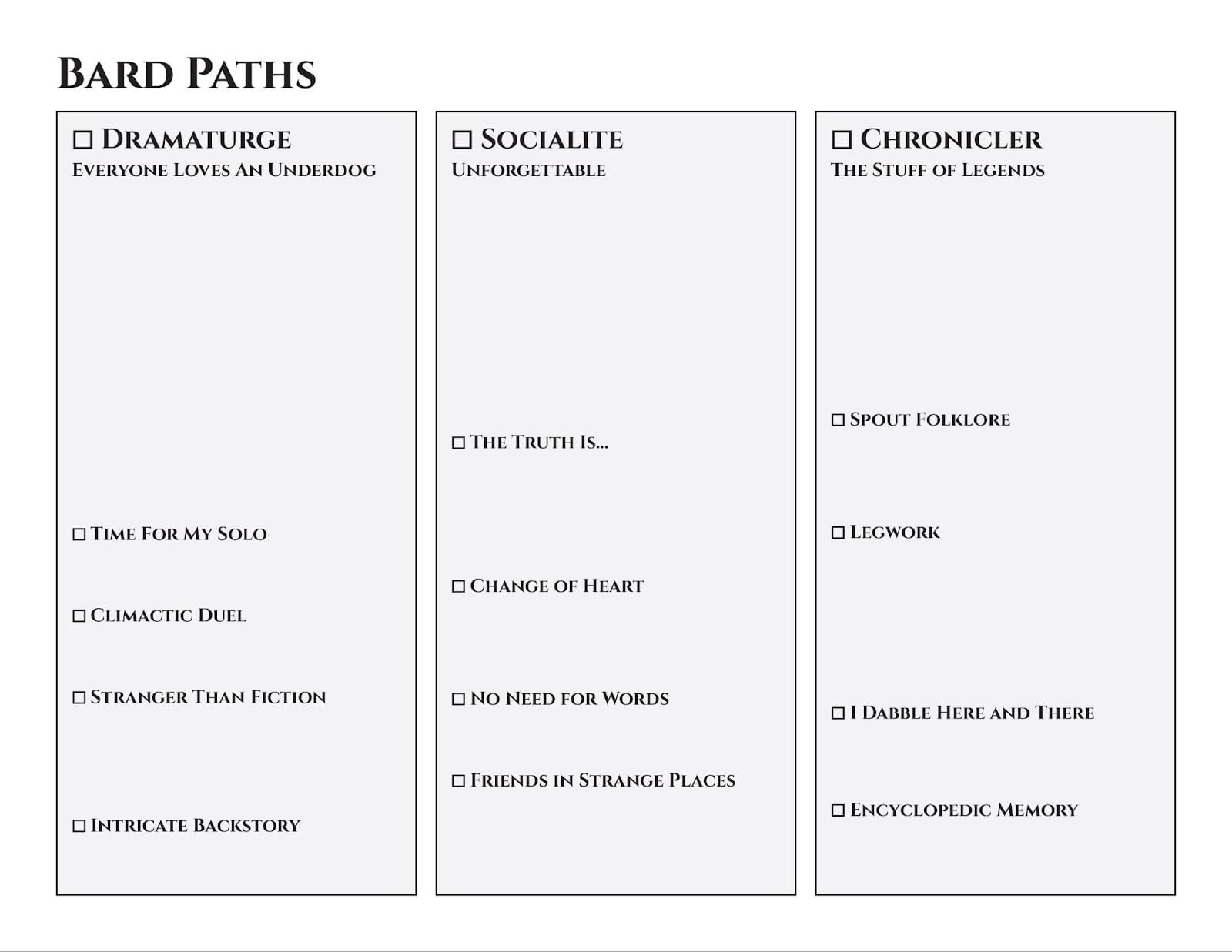
So far this new advancement system has done really well in private playtesting, and players have been very excited each time they advance. I hope it does just as well with the community once you get your hands on it. I worry about decision paralysis for the sheer number of moves and options, but hope that grouping moves into Paths helps a bit with that, in addition to making the game "feel like D&D" more by visually resembling subclasses from 5e.
Despite how drastic it is, I think Paths is not the most extreme experiment of the Final Alpha. That would instead go to Relationships and Bonds, which we'll talk about in the next post.
Thanks for reading!
- Spencer
Co-Designer Commentary - Helena
(Since only one of us writes each post, but we are both co-designing DW2, we're going to try having the co-designer add their thoughts at the end of some posts. Let us know what you think of this style.)
I agree with a lot of Spencer points here (as expected after a year+ of working together), but there are some things I’d like to add about simplicity and depth.
I love the idea of simplicity in theory but, in practice, I’m often disappointed by TTRPGs whose design eschews beyond barebones into what I’d call anemic. Having too few mechanical options to differentiate between archetypes makes the characters feel flat, and I get the feeling of “I can have fun with this for a few sessions, but I’ll eventually grow bored.” Moreover, the most important aspect loss in these cases is replayability. A character archetype that isn’t mechanically deep enough will be a “once and done” deal, at least for me and the people I usually play with. Borrowing a term from wrestling terminology, you have a gimmick, not a fully-realized, believable character.
On the other hand, too many options leads to the dreaded analysis paralysis and, as Spencer said above, it makes it harder for players to engage with the game from the get go. So, I’m all in favor of simplifying as much as necessary—and providing players with all the onboarding necessary to help them understand the design as best as possible—but I hope we don’t end up sacrificing mechanical depth and flavor in the altar of simplicity.