Relationships and "Leveling Up" Your Bonds
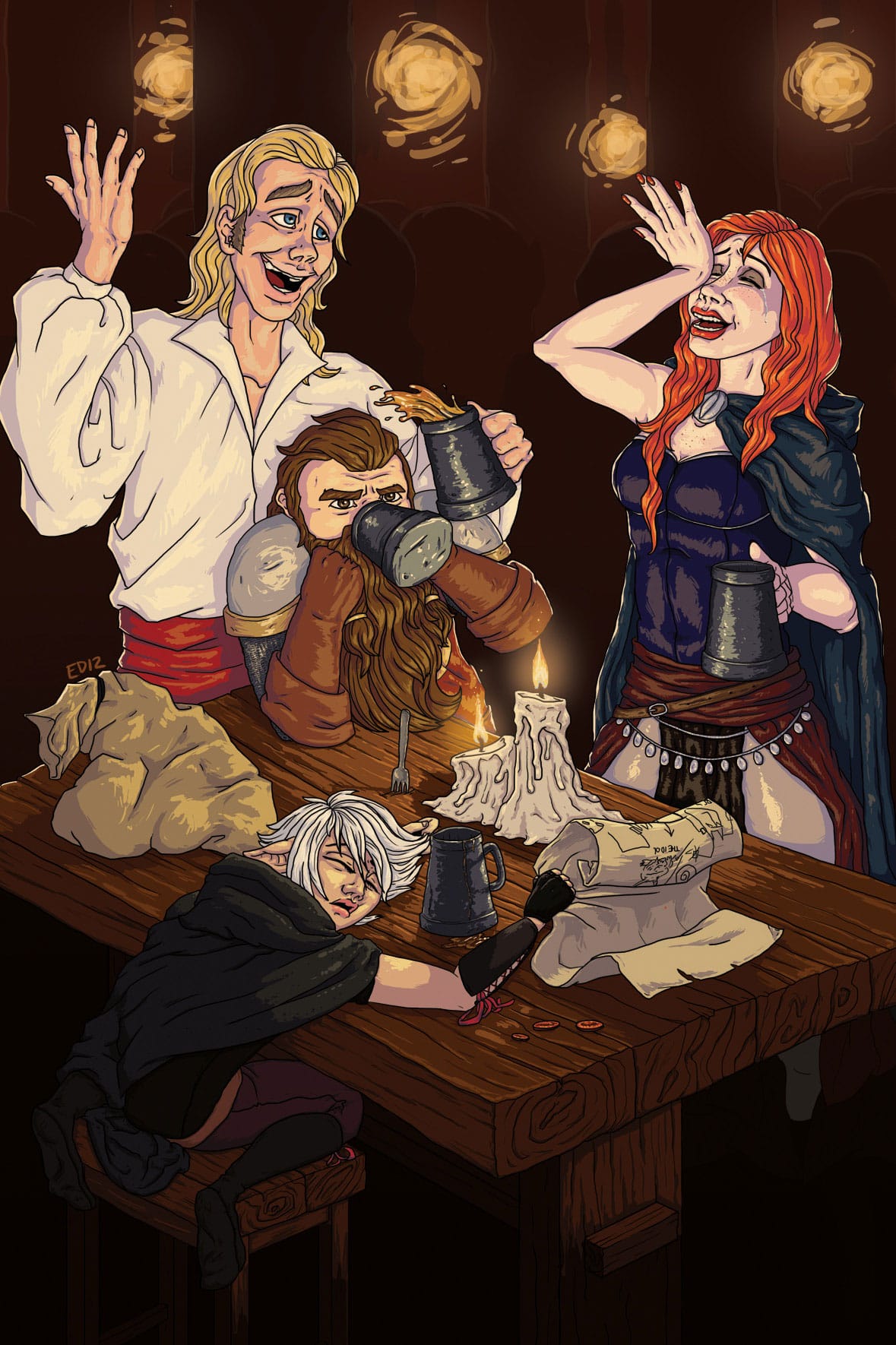
"Dungeon World 2 is about a group of messy people embarking on dangerous fantasy adventures and growing into a heroic found family."
Since the very beginning, this has been the cornerstone of Helena and myself's vision for this game. This journey of struggling people building connections with each other, and through those connections they not only help and heal each other, but also help the world at large. Everything we've designed for this game has kept that core vision in mind, even when balancing it with other factors (see Calibrating Dungeon World 2).
This is why we had a Group Playbook in the very first pre-alpha version of the game, and it's also why, for this Final Alpha, we're going to try replacing that Group Playbook with a different system altogether.
I love the group playbook. Gaining advancements as your group gets better at cooperating sounds amazing, and a lot of fans were really excited by it. It wasn't perfect, however, as the mechanics and advancements on the sheet acted as additional things players were expected to keep track of in addition to their own character sheet.
There's something else though, a slight disconnect that's more fundamental but also harder to convey, but I'm going to try.
Individual vs Collective
When you use a group playbook, individual characters and relationships often take a back seat, and players start approaching situations from the perspective of the group as a collective. Blades in the Dark and many of its descendants lean into this mindset. The group as a whole is considered the "main consistent character" of the game, with group playbooks defining the group's relationship with the world, and individual characters semi-frequently leave, go on hiatus, or switch out.
But Dungeon World 2 isn't about being a cohesive group, it's about growing into one, and starting with a Group Playbook is kind of like starting at the finish line. PCs need to earn those heroic moments of teamwork through the blood, sweat, and tears of continuous effort and care given to each other.
So how do we mechanically represent a group now? It's still an integral part of the game! Well, in real life, when a social group doesn't have a clear organization or purpose to create or maintain it, it usually exists because of the history and relationships between the individuals within. Even if "the group" as a whole might be hard to define, each of its members has a clear dynamic with every other member, especially when they are tightly knit.
That is how I want to represent that.
Deepening Relationships
In Blue and Red you started with a single bond with one other PC. Each bond has a few powerful mechanical uses, and over time you might have gotten more bonds.
In the Final Alpha, you instead start with a Relationship with every other PC. These Relationships act a lot like Bonds from DW1, and consists of:
- The Name of the PC it's with
- Its Details, which summarizes your feelings about them, often involving current situations or recent events
- Its Depth, which represents how well you know them and ranges from 0 to 3.
In response to events and conversations during play, PCs update Details and slowly gain Depth in their Relationships with each other. When someone reaches 3 Depth in one of their Relationships, they trigger a new move called Forge a Bond.
Forging Bonds
While Relationships are more focused on the immediate efforts, opinions, and contentions between two PCs, Bonds represent the core unbreakable connections between them. They aren’t always positive, and don’t negate disputes, but through Bonds you work together and help each other overcome hardship and strife.
When Forge a Bond is triggered, the PC who triggered it and the PC the Relationship is with mutually discuss and choose a Bond from the selection to gain, and they both write down the bond on their character sheet (there will be a third page to add and write choices outside of your class, such as Paths, Bonds, and similar). If they don't want to engage with Bonds right now, the pair of PCs can also advance an existing Bond, change to a new Bond, or ask each other questions and gain XP.
Everything in the Final Alpha is still subject to change before release, but here is an example Bond and its starting move.
Bond of Rivalry
Constantly pushing each other to greater heights, or longer falls, each of you refuses to be outdone by the other.
Starting Move - Always a Competition
When you pull off an impressive feat or dangerous trick, ask your rival if they agree. If so, you start winning and they start losing. If not, you may erase a Depth with them to treat it like they do. Who needs their opinion anyways? When you start each session, no one is winning or losing. When you End the Session, whoever is winning gains 1 XP.
Advanced Moves:
- Try to Keep Up
- That Still Only Counts as One
- Anything You Can Do, I Can Do Better
Other Bonds:
- Bond of Conviction - When it comes to values, morals, beliefs, and perhaps faith, the two of you are of similar minds.
- Bond of Guardianship- One of you protects the other and teaches them your ways. Perhaps about life or philosophy; or perhaps about fireballs.
- Bond of Family - Sibling, parent, cousin, friend. Through circumstance or blood, you know, love, and bicker with each other like no one else.
- Bond of Fascination - You share a passion for a topic, hobby, craft, or similar, and spend most of your time together discussing or working on it.
- Bond of Intimacy - You both have mutual feelings of romance, attraction, or similar affection, and have agreed to explore them together.
- Bond of Investigation - Whether solving street corner crimes or unraveling the mysteries of the universe, your minds work particularly well together.
- Bond of Mischief - You crave laughter and entertainment, especially when together. What’s a little troublemaking in its pursuit?
- Bond of Steel - You’ve fought against foes neither of you could defeat alone, but together you triumphed more times than you can count.
There are also a few Special Bonds that don't follow the same rules as the other Bonds.
Growing Together
While Relationships and their Depths are managed individually, Bonds are mutually shared. When a Bond is first gained, both PCs immediately gain access to its starting move. When either PC reaches 3 Depth with the other, they may choose for both PCs to gain an advanced move from that bond.
That number of bonds sounds like a lot to choose from, but in playtesting when looking at your own PC, the other PC, and their established social dynamic, it has been far easier to choose than it looks.
I hope that keeping bond moves on your own character sheet help players easily remember and reference them in play. I'm a bit worried about complexity with large groups over long-term play, as maintaining bonds with 4 or 5 other PCs can be a lot, but I can think of a few ways to curb that.
This is a total reimagining of PC-to-PC social dynamic mechanics compared to Blue and Red, and many of them have ambitious new mechanics and moves. It's been received really positively in private playtesting, and I'm very excited to see how people feel about it when they see it in full.
Spencer
Co-Designer Commentary - Helena
As Spencer mentions at the end, my main worry about this new system is complexity, as I also understand that some Dungeon World groups may not be interested in having these mechanics front and center.
On the other hand, I must say that I still feel that we can make the Group Playbook work with a few tweaks so, as with everything else, we need to hear from those of you following along and playtesting at home. Do you prefer the Relationship => Bond system better or would you like us to keep on iterating on the Group Playbook? Or something else entirely? Sadly, group dynamics and intergroup relationships is a woefully underdeveloped aspect of TTRPG design, so we don’t have as much literature/examples in previous games as with other mechanics/procedures to look at/get inspired by so, if you know of any examples you like, let us know! We’d love to give it a look.