
The Core Five Classes
As we mentioned on the first blog post on this series—leading up to the first Beta release—we want to share with all of you some insight about the design process at this stage, focusing especially on the whys and hows. We hope this is a good way of giving you a better perspective on our reasoning so, even if you disagree with it (or the results of it), we can still have at least a mutual understanding on the reasons behind our design.
So, with that out of the way, here’s all about the Classes in DW2 Beta!
Playbooks vs Classes
In Powered by the Apocalypse (PbtA) design—as explained by one of its originators—Playbooks show “[a] character’s starting point and trajectory, and maybe their ending point too, depending on the game. Just remember that it’s not only their fictional starting point, trajectory, and ending point, or their gamewise starting point, trajectory, and ending point, but both.”
Anyone who’s played the original Dungeon World will probably notice that most of those Classes really don’t fit this model. There are a few exceptions—the Paladin (and their Quest) and the Barbarian (and their Appetites) come to mind—but, in general, most Classes are just collections of dozens of Moves inspired by Basic D&D with no universally cohesive theme to them beyond that.
What’s more, many of those Moves don’t offer new and/or different ways of interacting with fiction. They just improve an already existing option, most of the time numerically and every once in a while qualitatively.
So, our main thrust with Class design in DW2 was to provide a clearer starting point and trajectory for player characters (PCs), both fictionally and mechanically.
To Distil Down the Purest Essence… Not!
During the first two Alphas (codenamed “Blue” and “Red”) we approached this conundrum by attempting to grab each Class and narrow its Moves down to 2-3 Starting Moves and 5-6 Advanced Moves. According to the feedback we received we were successful to a degree, but we had a feeling that we weren’t really making things significantly better, just different.
Then Spencer proposed a wild idea that made it all the way to the third and Final Alpha: what if we offered distinct, prepackaged ways of being that specific Class? After all, the main issue with Class design (when compared to Playbooks) is that Classes are so broad in concept and can mean many things—sometimes even contradictory ones—depending on which fantasy RPG or even D&D edition the designer likes/prefers.
Thus were Paths born.
So, after noticing their success, the remaining question was, but which Classes?
To Core or Not to Core
The original DW Classes were an amalgam of both the original classics of the genre (The Cleric, The Fighter, The Wizard), long-beloved early additions (The Druid, The Paladin, The Ranger, and The Thief), a controversial mess (The Bard), and a few late extras (The Barbarian, The Immolator).
From the very beginning, we knew that we wanted to start with just a few Classes so we could try out the design ideas we had. Even though we knew we would work on many more of those from the get go, the question about which ones to focus our efforts on first was the first one to answer.
In the end, we decided to work on five Classes and to associate each of them with one of the five Stats in the game. When we tried incorporating a sixth Stat (during Alpha Red), we did so by having an accompanying Class. We did so for simplicity’s sake, but also to focus these Classes’ design and allow them to serve as the baseline for the rest.
So, in short, our Core Five are:
- The Bard, the embodiment of Charisma (CHA)
- The Cleric, most closely associated with Wisdom (WIS)
- The Fighter, the Strength (STR) Class
- The Rogue, master of Dexterity (DEX), and
- The Wizard, paragon of Intelligence (INT)
We have been working on these five since pre-Alpha (~Nov 2024), so we’ve been able to try many approaches and have a very clear idea of what we want out of each of them. Here’s a few more details about each of them.
The Bard
The main challenge with The Bard was to provide it with a focus and identity that was uniquely its own. Strangely enough, the answer for us lied in expanding the scope of the Class—making it about being an artist and letting each Player decide which type of performative art fits their idea of the character best.
Its Starting Move is, obviously enough, Perform Your Art, and it’s a great way for any Bard to help other characters. Since historically this is the most “all over the place” Class, its Paths reflect this. The first one, Dabbler, it’s all about being someone who knows a bit of everything that’s related to knowledge and wizardly (aka arcane) magic. The next one, Diplomat, is all about the art of intrigue, politics, and general people manipulation. Finally, the Swashbuckler is the “action Bard”, having a taste for the overlydramatic, the extremely risky, and the stylish, even—especially!—when fighting.
The Cleric
In contrast, the problem with the Cleric is that its focus seemed so narrow (basically “priest with divine powers”) and, at the same time, as soon as we tried it to expand it a bit from that very limited perspective we immediately started intruding on other Classes fictional territory: lore (wizard), nature (druid), and warrior (paladin), are a few of those disruptive examples.
Its Starting Move, Invoke the Divine, is all about channeling the deity they serve to create miracles. As one of the Classes that has access to magic by default, this'll be the first you'll see the interaction between it and the Core Move Cast a Spell, which we'll talk more about in our next entry in this series.
As for Paths, in the end we decided to go for a roster that represents the most common denominator among Cleric types. That's how we ended up with the Healer, which embodies the fantasy of being a super medic that can heal bodies—even bring them back from recent death!—and appears trustworthy by default.
We also decided to include the Oracle, an archetype that's all about having a much closer and personal relationship with a deity, which ends up granting the visionary impossible knowledge and other supernatural abilities.
Finally, the Warpriest is there to fulfill the fantasy of fighting directly against evil and trying to vanquish it from the world. At first glance this seems like Paladin territory, but the specific Moves of the Warpriest compared to the Paladin should reinforce their separate identities.
The Fighter
The Fighter's usually considered the baseline against which other fantasy archetypes (such as Classes) are measured against, the vanilla that helps other flavors to differentiate themselves, so to speak.
We definitely thought the Class deserved better, at least in terms of identity and specialness. We didn't and still don't want to design a “boring” Class, so we decided to listen to the popular sentiment and we brought back Signature Weapon as the Fighter's Starting Move.
In the case of its Paths, we tried to put as many distinct and unique ways of being a Fighter as we could think of. That's how the Brawler came to exist, as a take on the classic combatant who is a weapon in and of themselves, and who needs no weapon or armor to be a menace.
The next Path could have existed in either the Wizard or Fighter Class but, for now, we thought it fit better in the overall fiction of the latter. Enter the Spellblade, a Fighter that combines steel and sorcery in a powerful combo. This has been a very popular character in fantasy fiction for a while now, and we wanted to include it in the core roster so people can have it available as soon as possible.
Finally, we wanted to include an option that shows that a Fighter can be way more than muscle or speed. The Tactician is thus all about fighting smartly, supporting their allies, and having a lot of experience on a battlefield.
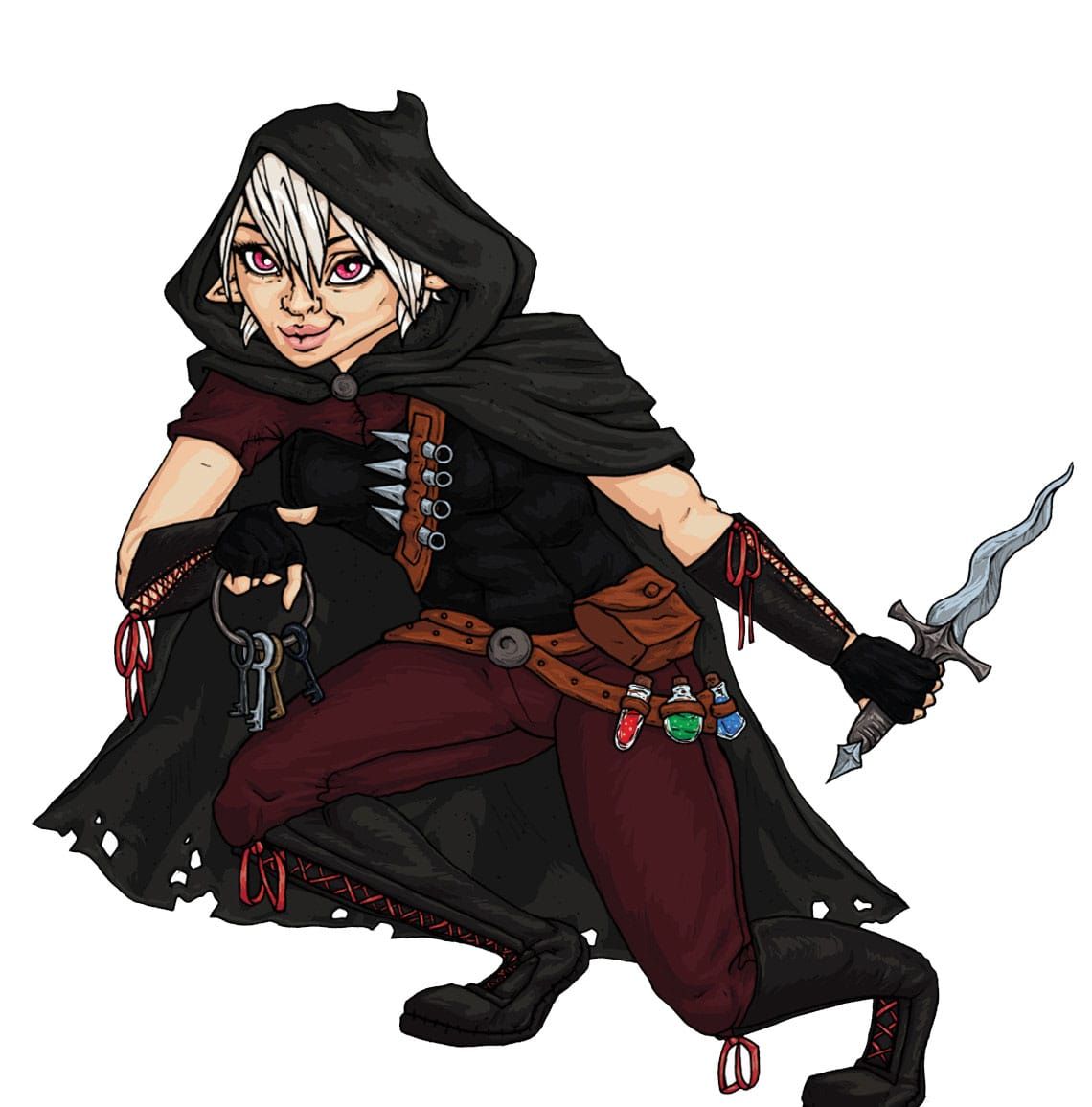
The Rogue
The change in name (from the original Thief) is purposeful and deliberate. Since the Basic D&D days this Class has come to include a lot more ideas and fictional archetypes, so we want it to update it and present a refreshed version of it.
We started with a very traditional Starting Move, though. Tricks of the Trade allows you to literally cheat (legally) while doing roguish things, which we consider is both in fiction, flavorful, and a pretty good way to do something beyond giving advantage.
As for the Paths, they include such quintessential examples as the Assassin, master of poisons and lethality in other ways. We also included a bit of a curve ball among this Path’s advanced Moves, but just because we thought it was a great thematic fit (and a nod to specific version of the archetype in one D&D edition).
The Burglar is, on the one hand, our roguiest rogue, the one that most closely resembles the OG Thief. On the other, it’s also built from a more benign interpretation of the Class, inspired by fictional characters such as Aladdin and Bilbo Baggins.
Finally, the Spy is our Path that’s all about infiltration and high-risks when dealing with powerful people. We think this archetype is very popular in fiction in general, and often misunderstood because of the conflation between spies (agents who do primarily reconnaissance and information gathering) and operators (agents who go on the field to execute targets or do missions). As always, we’ll eagerly await your feedback on whether you think this is a core Rogue Path for you—or not.
The Wizard
Last, but certainly not least, the Wizard is a Class we’ve been consistent about modeling after the D&D version of it. Specifically, we like the idea of the 8 schools of arcane magic, and how they give the Class both immense flexibility and different identities depending on specializations.
As a result, it won’t probably surprise you that Weave the Arcane—the Wizard’s Starting Move—is all about combining substances and verbs to create unique magical effects.
As for the Paths, we decided to go all in on the idea of specialties and focus on the three that seemed the most distinct and popular with the fantasy gaming community at large. That’s how we came to include the Evoker, the classic wizard-goes-blasting archetype, focused on the idea of destructive magic and tricks. The Evoker is all about risk and reward, something we feel goes very much in line with the stereotype.
Next we have the Illusionist, a certified classic ideal of a magic-user. We also know that illusions are very hard to implement at the mechanics level without introducing cumbersome extraneous rules, so we did our best to present a version that still plays with the same toys as the rest of the Wizards, but that feels unique and distinctive.
And finally we have the Necromancer, the very controversial magician of the dead and the undead. We tried to incorporate as many ideas and usual “powers” of Necromancers in fiction in the Path, from creating individual undead, having a horde at your command, or even create an abomination of necromantic magic!
And that’s it! Sorry about the long blog post, but we wanted to give you a detailed insight into our Class design process in general (especially when it comes to Beta and beyond), and also to present you with the Paths from a fiction-first perspective.
Next week, I’ll be back to talk about all things magic.
Until then, happy gaming!
- Helena