
The How’s & Why’s of Wealth & Treasure in Dungeon World 2
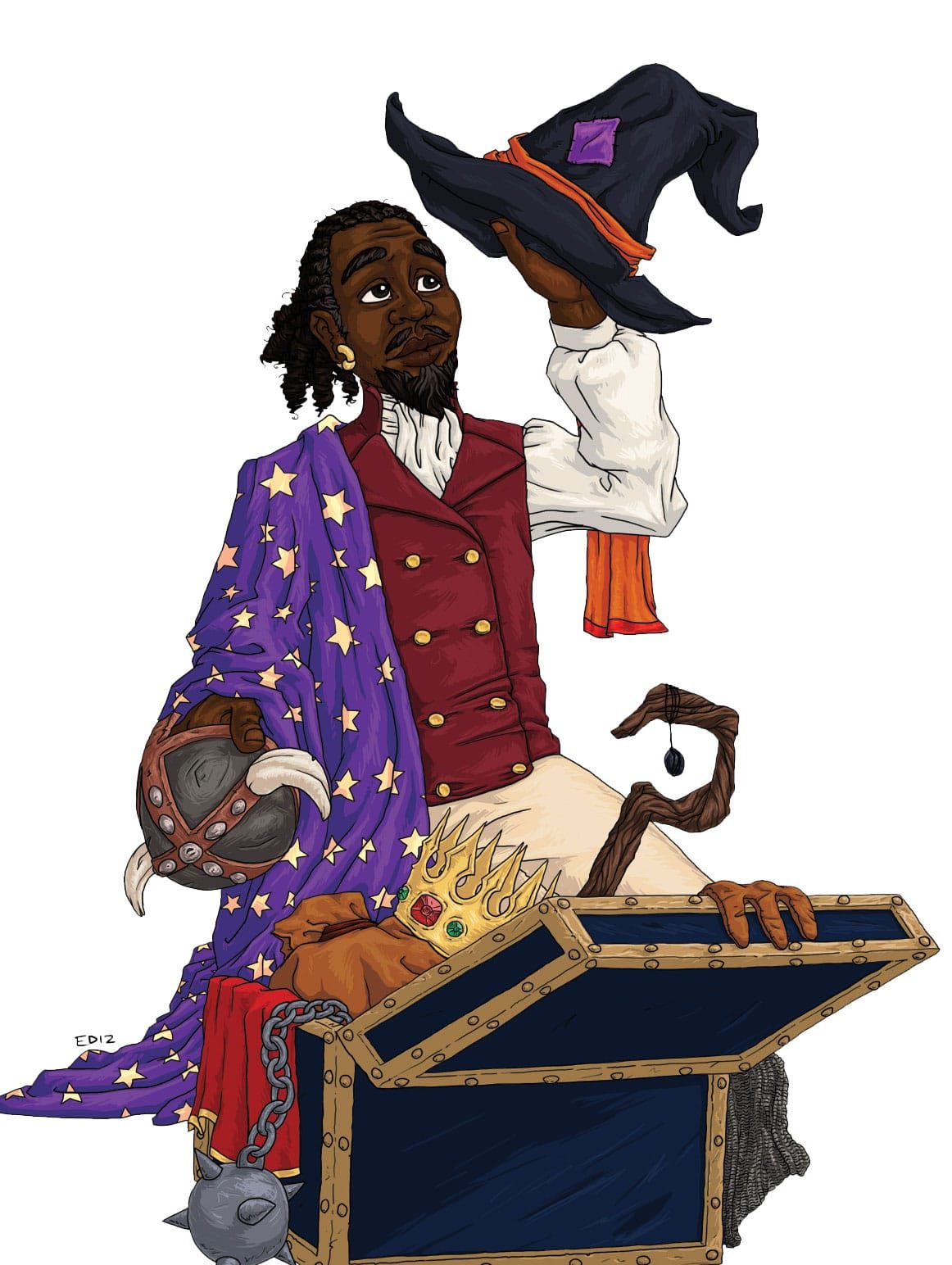
A staple of fantasy roleplaying games (FRPGs) from its earliest years, wealth and treasure have been one of the aspects we’ve discussed and kept in mind from the very beginning of our Dungeon World 2 (DW2) design. We’ve included a couple of alternative takes on it throughout the years(!) of development but, as we approach our Beta v4 release (and the final text in the very near future), we feel that we can now talk confidently about our current solution—and explain our design intent in more detail.
The Continuum
When it comes to wealth & treasure in FRPGs, there’s basically a continuum with two extremes in regards to gaming rules implementation. On the one hand you have the “accounting” extreme, where you start with a certain amount of currency (sometimes randomly, sometimes fixed), alongside some basic equipment, and then each player is in charge of tracking each expense they make, as well as each time they get any income through their adventuring.
On the other hand, we have the “handwaving” extreme, which abstracts wealth & treasure as much as possible, to the point of ignoring it completely as long as it isn’t relevant in the fiction.
So, where does DW2 stand?
How It Started
During the first Alpha release (codenamed “Blue”), we tried an abstraction that used only Wealth as a pseudo-PbtA Stat, from +0 to +3, that described ALL the PCs combined capacity for acquiring things. By the time we reached the next release (“Red”), we introduced Lifestyle status (from Destitute to Gold) as a result of accumulating treasure, which gave you a “discount” when buying items. Finally, by the time we reached the Final Alpha, we let go of the concept of a Group Playbook, and we implemented a very simple version of Treasure, which allowed you to buy things directly. The first release of Beta (v1 or “Quickstart”) didn’t include our rules for treasure & wealth, but it already pointed out that we had decided to move them to the Campaign section of the rules.
As a quick aside, in an attempt to make the game easier to learn for new players, we’ve decided on a laddered approach, with specific subsets of the rules coming into play depending on how much of a time investment the current game is supposed to be. As such, we divided the whole game into three distinct experiences: One-Shot, Adventure, and Campaign Modes. The latter includes all the rules of the game, and it is the most “complete” experience but, conversely, it requires all players to manage more rules while playing. The other two have increasingly less rules and, we hope, are then more approachable for a prospective group of players.
By the time we released the Beta v2 (and with some addenda and corrections in v3), we revealed our current vision for wealth & treasure in DW2. In short: a Treasure Track and Wealth Tiers. Before we delve into the mechanical details of each, let us talk a bit about what inspired this.
The Problem of Treasure
Having any mechanics in a FRPG about money leads inevitably to two design conundrums: a) the establishment of a fictional economy and b) the need for things to be bought for increasingly more expensive prices.
The matter of fictional economy is, of course, one that varies heavily from table to table. Some players love to engage with the idea of how a pseudo-medieval economy would react to powerful injections of money as a result of the PCs’ derring-do’s. This aspect is also deeply tied with the tradition of Game Masters (GMs) doing their own fantasy world-building (“homebrew”), with their own idiosyncrasies and unique features—economy being one of them.
As for goods and services, any FRPG where the PCs acquire wealth at a quick enough pace will result in them having the means to buy titles, land, and even have enough to build large structures (such as castles and towers) in a relatively short amount of time. On the other hand, some lean on allowing PCs to purchase magic items (and sometimes even Artifacts) at exorbitant prices, somehow managing to keep players interested in whatever treasure their PCs can acquire.
When a FRPG fails to contain such opportunities for expenditure, then the players are no longer motivated by, as Matt Colville puts it, “enlightened self-interest” AKA, greed. If that happens, all the economy mechanics, from list of items to treasure awarded become vestigial in the overall design, and useless at the table without much tinkering—i.e. redesign—on the part of GMs and/players.
Even when such subsystems are put in place, however, there are still risks involved.
Getting Rich
Cowboy Bebop is a wonderful anime about misfits trying to make ends meet by becoming bounty hunters… IN SPACE. In spite of this [and SPOILERS for a 28-year-old show], they never catch a single bounty in 26 episodes. This is because of many reasons, but chief among them is that, if the characters in the show ever get rich enough, they no longer have a reason for being together and/or going bounty hunting.
In other words, the show has no more narrative fuel to go on.
So, in conclusion, in a FRPG you need not only to provide enough things to use your money on, but also you need to not give the PCs enough that they become too comfortable and decide not to adventure again.
Which leads us into our solution for this two-pronged issue in DW2.
How Is It Going
As mentioned above, we have implemented a dual and interconnected way of managing money in DW2: the Treasure Track and Wealth Tiers.
The Treasure Track is a simple set of boxes that you mark every time you get Treasure while adventuring. So, if you find a little sack filled with gold, you mark one box on the Treasure Track. A pearl? 1 box. A painting? 1 box. And so on and so forth.
When you accumulate enough treasure on the Track, you change your Wealth Tier. You usually start a campaign at Poor, and you need 6 marks to move from Poor to Modest. These Wealth Tiers determine which things you can buy at no cost, which ones will cost you clearing one box on the Treasure Track, and which ones are simply beyond your means.
Each item in the game, then, has a Wealth Tier associated with it. For example: light armor (such as studded leather or a padded gambeson) requires you to have a Modest Wealth Tier to buy (clearing one box on the Treasure Track when you do so), whereas heavy armor (such as a full plate) requires you to have a Rich Wealth Tier before you can acquire it.
“Why Didn’t You Go with Coins?”
As we explained above, using a simple coin system would require imposing an economic fantasy system on the GM and players that may simply not fit the fantasy world they wanna play in. We don’t want to limit GM and players’ imagination, so our solution is one that should make sense—on an abstract level—in most fantasy worlds.
Furthermore, the lack of infinite accumulation of coins allows us to move away from the “power fantasy” of buying anything and anyone, and keeps DW2’s fantasy “grounded” in the “misfits who need to adventure to get by” of something like Cowboy Bebop.
Finally, our wealth & treasure subsystem was deeply inspired by Terry Pratchett’s Discworld’s “Sam Vimes theory of socioeconomic unfairness” (aka the “boots theory”), which explains why poor people often haven’t access to quality goods, as they don’t have the monetary power and, instead, have to conform themselves with whatever they can pay to make ends meet. This is very much in line with the fantasy that’s foundational to DW2 (not to mention the lived experience of at least one of its designers).
Thanks for reading… And happy gaming!